Customer Anomaly Agent
Spot at-risk customers before the sales drop becomes a trend
Stop finding out about customer churn after it's already happened. This agent analyses your weekly sales data, detects customers whose buying behaviour has dipped below their own baseline, and routes the right intelligence to the right store manager — so your team acts early, not in hindsight.
The result: 4 hours reduced weekly analysis time, and 100% store coverage with consistent methodology.
What it does
- Analyse customer sales trends across 12 weeks
- Detect and rank underperforming customers per store
- Send seasonally adjusted summaries to store managers
Tools & Integrations

Opens Abundly with a starter prompt — our AI helps you tailor it to your business
The Challenge
Your sales data tells a story.
Your sales data tells a story. The problem is that nobody has time to read it. Every week, transaction data piles up across stores and customer accounts. Somewhere in that data are early warning signs — customers who used to buy regularly and have quietly started pulling back. But spotting them requires someone to sit down, pull the numbers, compare this week against last month, adjust for seasonal patterns, and then work out which store owns which customer. In practice, that doesn't happen. Store managers are busy running their stores. Analysts are stretched across priorities. And the customers who are drifting away don't announce themselves — they just... stop showing up. Even when teams do attempt a manual review, the output is inconsistent. One manager gets a rough list. Another gets nothing. The thresholds for what counts as "underperforming" shift depending on who's doing the analysis and how much time they have. Seasonal swings get misread as genuine declines, or genuine declines get written off as seasonality.
When at-risk customers go unidentified, they become lost customers. And lost customers rarely come back without a reason to.
The Agent
The Customer Anomaly Agent changes the game.
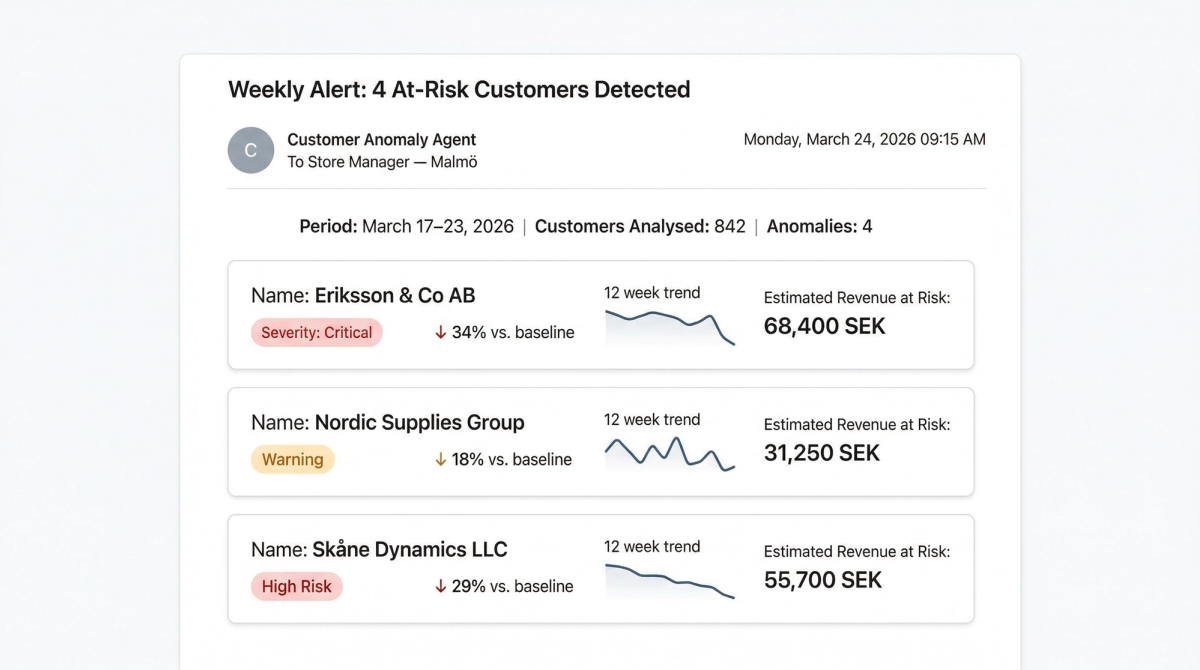
The Customer Anomaly Agent changes the game. Every Monday morning, the agent receives a fresh Excel file containing 12 weeks of customer sales data. It runs the analysis automatically — comparing each customer's recent four-week performance against their 12-week baseline, applying seasonal adjustments to filter out expected fluctuations, and ranking the results by severity. It then segments the findings by store, pulling the top 15 underperforming customers for each location into a clean, readable summary. Before anything goes out, the summary lands in a human approval step. The agent sends the report to the designated reviewer — so there's a check on the output before it reaches store managers. Once approved, the agent fires off individual emails to each store manager with only the customers relevant to their store. No digging. No forwarding. No manual re-sorting of a shared spreadsheet.
The approval step keeps a human in the loop without slowing things down — it's a quick review gate, not a bottleneck. Managers get focused, relevant intelligence, not a 500-row spreadsheet they'll never open.
The Impact
Speed
4 hoursReduced weekly analysis time
The agent handles the full cycle — ingest, analyse, segment, send — automatically every Monday morning, replacing hours of work.
From a half-day task to zero manual effort.
Quality Improvement
100%Store coverage with consistent methodology
Every manager receives a report built on the same methodology — no variance in thresholds, no missed stores.
Quality Improvement
15At-risk customers surfaced per store, every week
Managers get a concrete shortlist to act on each week — early outreach is far cheaper than re-acquiring lost customers.
But the real win isn't just the time saved or the reports landing on time — it's the shift from reactive to proactive. Instead of discovering that a customer churned three months ago, your managers know today that something has changed. That window — between the dip and the departure — is where the relationship can still be saved.
Do you want this agent?
Start with a pilot and see how this agent can transform your finance process in just 4-6 weeks.