Month-End Close Agent
Spot the numbers that need your attention — before anyone asks
Stop wading through rows of bookkeeping data hoping the important deviations will jump out at you. This agent reads your bookkeeping system data at month-end, compares it against prior periods and budget, and flags the variances that actually matter — so your finance team spends its time investigating anomalies, not hunting for them.
The result: 4 hours of manual comparison eliminated each month-end, and 100% variance detection coverage, every month.
What it does
- Read and structure bookkeeping data
- Compare costs and revenues against budget and prior months
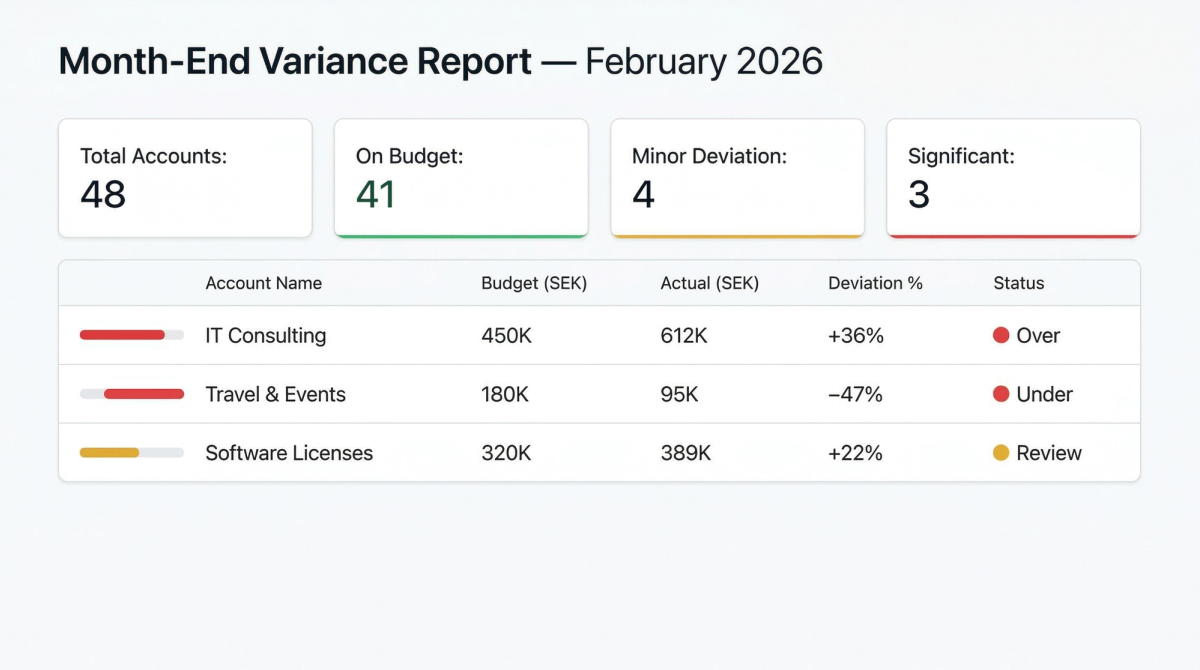
- Surface significant deviations for review
Tools & Integrations

Opens Abundly with a starter prompt — our AI helps you tailor it to your business
The Challenge
Month-end close should be straightforward.
Your bookkeeping data is all there — sitting in your bookkeeping system, complete and up to date. But turning that raw data into a meaningful picture of what changed, what deviated, and what needs attention is a manual exercise. Someone has to export the figures, pull up last month's numbers, cross-reference the budget, and then eyeball the comparison line by line. That takes time. It takes focus. And it's the kind of repetitive analytical work that invites errors and fatigue in equal measure. The deeper problem is that not everything gets caught. When you're working through a spreadsheet under time pressure, it's easy to overlook a cost that's crept up gradually, or a revenue line that's quietly underperformed for two months running. The deviations that matter most aren't always the obvious ones.
When month-end analysis depends on manual comparison, you miss the signal in the noise — and decisions get made on an incomplete picture of your financial health.
The Agent
The Month-End Close Agent changes the game.
At month-end, the agent connects to your bookkeeping system data and runs the comparison automatically — costs versus budget, revenues versus prior periods, actuals versus trend. It doesn't surface everything. It surfaces what's significant. Rather than handing your team a raw data dump, it highlights the deviations that warrant attention: the cost category that's running 18% above the prior three-month average, the revenue line that's come in below budget for the second month in a row. Your finance team can ask it directly — "What's moved the most this month?" or "Where are we furthest from budget?" — and get a clear, structured answer in seconds. It works the same way every month-end, with the same rigour, without needing to be reminded.
Once the agent has surfaced the material variances, your team has everything they need to go straight into analysis — understanding why something moved, not whether it did.
The Impact
Speed
4 hoursOf manual comparison eliminated each month-end
Exporting data, building comparisons, and scanning for anomalies — a half-day process — is now done in minutes.
Quality Improvement
100%Variance detection coverage, every month
No fatigue, no skipped rows, no overlooked figures. Every line checked against the same benchmarks, every time.
The deviations that used to slip through now get caught — before they become a problem.
But the real win isn't just faster reporting — it's a finance team that arrives at month-end conversations already knowing where to look. Instead of spending the first hour of a review meeting working out what happened, your team walks in with the picture already formed. The conversation starts at insight, not discovery.
Do you want this agent?
Start with a pilot and see how this agent can transform your finance process in just 4-6 weeks.